

Configuration Options
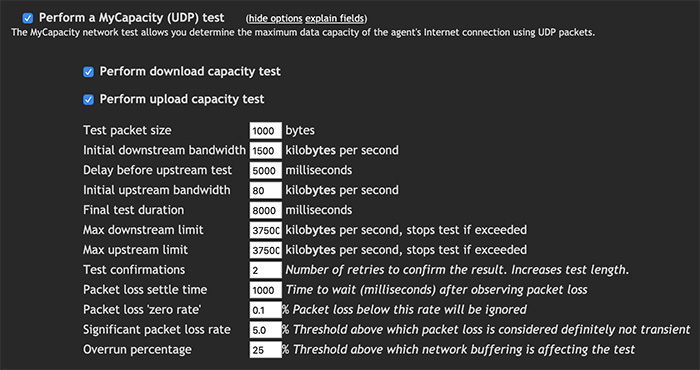
Capacity test configuration options
| Option | Description |
|---|---|
| Perform Download Capacity | Enable or disable the downstream (server to client) capacity test. When checked, the test measures how much data the connection can receive. |
| Perform Upload Capacity | Enable or disable the upstream (client to server) capacity test. When checked, the test measures how much data the connection can send. |
| Test Packet Size | The size of each UDP packet in bytes (not bits). This should reflect the type of traffic you want to simulate. For VoIP testing, 160–214 bytes represents a typical G.711 voice payload. For general data transmission, 1420–1460 bytes is typical and closely matches a standard network MTU. The test calculates how many packets per second to send based on this size and the current target bandwidth. |
| Initial Downstream Bandwidth | The starting bandwidth level for the download test, in kilobytes per second (e.g., 1500 KB/s ≈ 12 Mbps). The test begins sending data at this rate and ramps up in cycles if no significant packet loss is detected. Setting this close to but below the expected connection speed reduces the number of cycles needed to reach the result. |
| Delay Before Upstream Test | A pause in milliseconds between completing the download test and starting the upload test (e.g., 5000 ms = 5 seconds). This allows the connection to settle after the download test so residual congestion or buffering does not affect the upload result. |
| Initial Upstream Bandwidth | The starting bandwidth level for the upload test, in kilobytes per second. Behaves the same as the downstream setting — the test ramps up from this value and adapts based on observed packet loss. |
| Final Test Duration | Once the test has identified the connection's maximum sustainable rate, it runs one final measurement at that rate for this duration (in milliseconds). The result reports the actual throughput achieved during this period, excluding any lost packets. A longer duration produces a more reliable final measurement but increases overall test time. |
| Max Downstream Limit | An upper ceiling for the download test in kilobytes per second. If the test ramps up to this rate it will stop and report the result, even if no packet loss has occurred. Use this to prevent the test from pushing beyond a known connection limit or consuming excessive bandwidth. |
| Max Upstream Limit | An upper ceiling for the upload test in kilobytes per second. Behaves the same as the downstream limit — the test will not attempt to exceed this rate. |
| Test Confirmations | The number of additional cycles the test runs to confirm the discovered maximum rate. A higher value (up to 10) improves accuracy on connections that experience sporadic or random packet loss, but increases overall test duration. |
| Packet Loss Settle Time | Time to wait in milliseconds after packet loss is observed before the next test cycle begins. This gives the network time to recover from congestion so that residual loss from a previous cycle does not carry over and affect the next measurement. |
| Packet Loss 'Zero Rate' | A percentage threshold below which packet loss is treated as negligible and ignored. For example, a value of 0.1% means that loss at or below this level will not cause the test to back off. This filters out minimal background loss that is normal on many connections. |
| Significant Packet Loss Rate | A percentage threshold above which packet loss is considered definitive rather than transient. When loss exceeds this rate during a cycle, the test treats it as a clear indication that the connection cannot sustain the current bandwidth and immediately backs off. Loss between the zero rate and this threshold is treated cautiously — it may trigger a retry rather than an immediate backoff. |
| Overrun Percentage | A percentage threshold that detects when network buffering (bufferbloat) is artificially masking packet loss. If the measured throughput exceeds the expected rate by more than this percentage, the network is likely buffering packets rather than delivering them in real time. The test flags this to ensure the reported result reflects true sustainable capacity, not buffered bursts. |